

EB-1C Support for Multinational Leaders
Help executives and managers move from temporary transfer to long-term U.S. immigration support with a more structured, attorney-backed process.
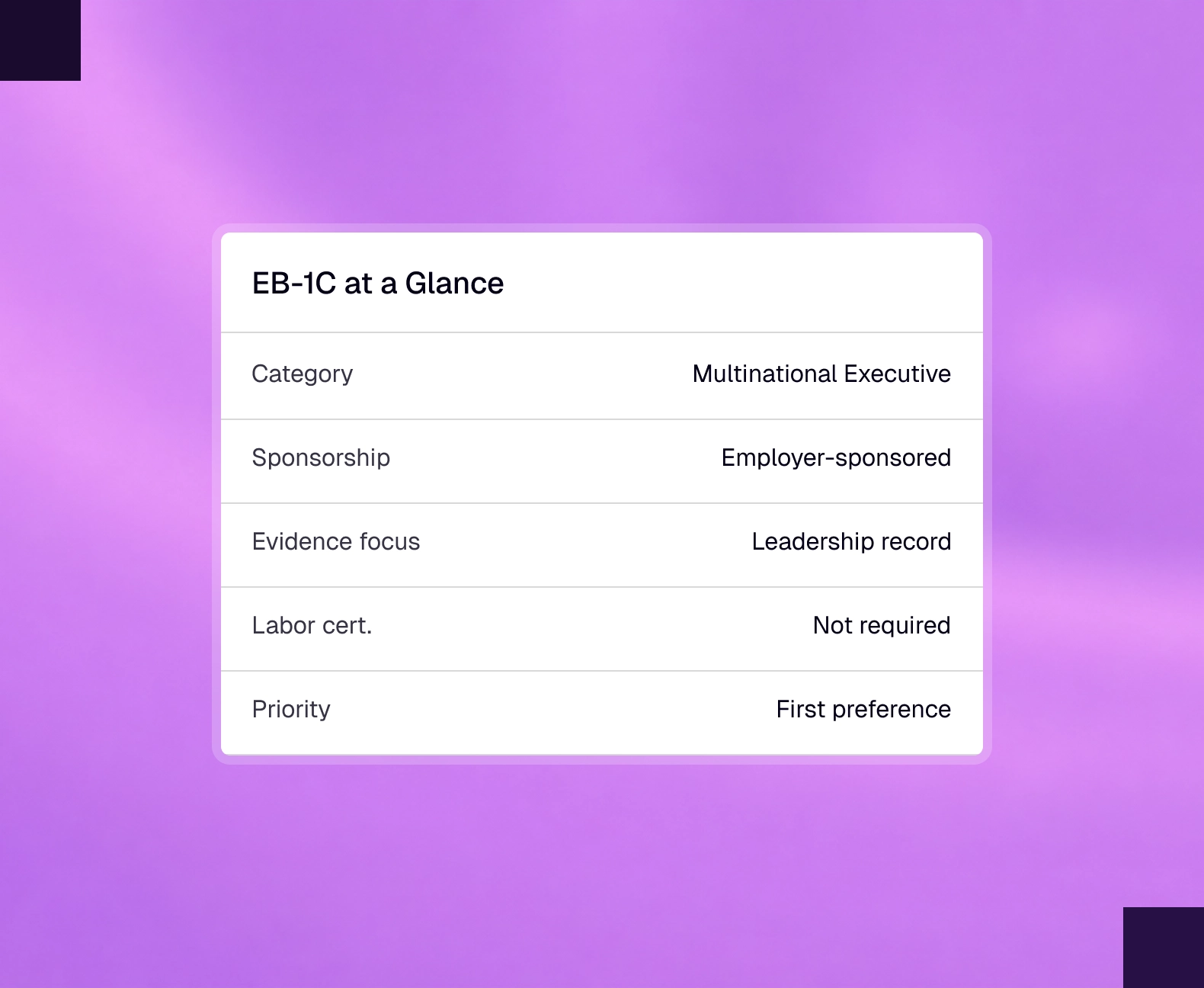
Is EB-1C the Right Fit?
EB-1C may be a fit for multinational executives or managers who have worked abroad for a related company and are moving into a qualifying U.S. leadership role.
01
Leadership Role
The beneficiary has executive or managerial responsibilities.
02
Multinational Company Structure
The U.S. employer has a qualifying relationship with the foreign company.
03
Prior Foreign Employment
The beneficiary has qualifying employment abroad with the related company.
04
Long-Term U.S. Role
The U.S. position supports a permanent executive or managerial need.
What EB-1C is Designed for
EB-1C supports certain multinational executives and managers pursuing permanent residence through a qualifying U.S. employer.
It is often used by companies that need long-term leadership continuity in the United States.
Profiles That May Qualify
EB-1A is not limited to a single profession. The pathway is designed for individuals whose work has had documented impact across a range of fields.
- Executives
- Managers
- L-1A holders
- Global operators
- U.S. expansion leaders
What a Strong Case Needs to Show
A strong petition depends on how clearly the evidence supports the category requirements.
Show the ownership and control relationship between the U.S. employer and the foreign company.
- Ownership records
- Corporate structure chart
- Formation documents
- Stock ledger / Cap table
Show that the beneficiary’s qualifying role abroad was primarily executive or managerial.
- Foreign org chart
- Detailed job duties
- Employment records
- Payroll records
Show that the permanent U.S. role is primarily executive or managerial, with meaningful authority and responsibility.
- US job description
- US org chart
- Reporting lines
- Decision-making authority
Show that the U.S. business is actively operating and has the organizational structure to support the proposed leadership role.
- Tax returns
- Financial statements
- Payroll records
- Customer contracts
How LegalOS Supports the Case
LegalOS organizes the evidence gathering and case preparation workflow so your attorney can focus on strategy — not paperwork.
01
Case Fit Review
Assess whether the company structure, role history, and U.S. position align with the EB-1C pathway
02
Company Evidence Organization
Help organize documents that support the qualifying relationship and business context.
03
Role Narrative Support
Structure the executive or managerial role story across both the foreign and U.S. positions.
04
Attorney Review
Experienced immigration attorneys review the case materials for quality and legal confidence.
From Profile Review to Filing Support
We keep the process to three clear steps. Longer workflow details are covered inside the platform once you get started.
Confirm Eligibility Signals
Review company structure, beneficiary history, and leadership responsibilities.
Build the Evidence Library
Organize company documents, role materials, and supporting evidence.
Prepare and Review
Prepare the case package for attorney review and filing support
Pricing for
EB-1C
Purple
Complete EB-1C I-140 petition preparation and filing with experienced immigration attorneys, clear communication, and visibility every step of the way.
$9,000
What's included:
- Full EB-1C I-140 filing
- Live case tracking
- Attorney review backed by 40+ years of immigration experience
- Standard preparation
- Personalized case timeline
- RFE and NOID responses included
Gold
For faster, more hands-on support, Gold adds priority preparation, weekly attorney check-ins through filing, and a 60% money-back guarantee.*
$15,000
What's included:
- Full EB-1C I-140 filing
- Live case tracking
- Attorney review backed by 40+ years of immigration experience
- Priority preparation in 48–72 hours
- Weekly attorney check-in calls through filing
- Personalized case timeline
- RFE and NOID responses included
- 60% money-back guarantee* Eligibility and conditions apply. See our terms for full details.
Compare Related Green Card Pathways
Not sure which category fits your profile? Review the key differences between employment-based green card pathways.
EB-1A
Founders, researchers, engineers, and recognized experts with documented field impact
EB-1C
For multinational managers and executives transferring into a qualifying U.S. leadership role.
EB-2 NIW
For qualified professionals whose work may serve the national interest. Self-petition available.
FAQ
What is the EB-1C green card?
The EB-1C is an employment-based green card for certain multinational executives and managers. It allows a qualifying U.S. employer to sponsor an executive or manager who previously worked for a related organization abroad and will continue in a qualifying leadership role in the United States. EB-1C is part of the first-preference EB-1 category and does not require PERM labor certification.
Who is a good fit for the EB-1C green card?
EB-1C may be a strong fit for executives or managers who have qualifying employment abroad with a related company and will hold a permanent executive or managerial role with the U.S. employer. The U.S. petitioner must also have been actively doing business in the United States for at least one year.
Does EB-1C require a U.S. employer?
Yes. EB-1C is employer-sponsored and must be filed by a qualifying U.S. employer. The U.S. petitioner must have the required relationship with the foreign organization that employed the beneficiary and intend to employ the beneficiary in an executive or managerial capacity.
Can I self-petition for an EB-1C green card?
No. Unlike EB-1A and EB-2 NIW, EB-1C is not a self-petition category. A qualifying U.S. employer must file the Form I-140 petition on behalf of the multinational executive or manager.
What is a qualifying company relationship for EB-1C?
The U.S. petitioner and the foreign organization must have a qualifying relationship that meets USCIS ownership and control requirements. The evidence should clearly establish how the two entities are related and show that both organizations are actively doing business
How long do I need to have worked for the foreign company?
Generally, the beneficiary must have worked outside the United States for the related organization for at least one year during the applicable three-year period. That foreign employment must have been in a qualifying executive or managerial capacity.
Do I need to have an L-1A visa before applying for EB-1C?
No. Prior L-1A status is not required for EB-1C eligibility. The two categories have similar multinational executive and manager concepts, so L-1A holders often pursue EB-1C later, but an applicant can qualify for EB-1C without first holding L-1A status if the EB-1C requirements are independently met.
Can a new U.S. office qualify for EB-1C?
Not immediately. The U.S. petitioner must have been actively doing business in the United States for at least one year before filing an EB-1C petition. A newly established U.S. operation may therefore need to build the required operating history before becoming eligible to sponsor an EB-1C case.
What counts as an executive or managerial role for EB-1C?
USCIS looks at the person’s actual responsibilities, not just their job title. Executive roles generally involve high-level decision-making and organizational direction, while managerial roles may involve managing employees or managing an essential function of the organization. The petition should clearly show that the beneficiary’s primary duties are executive or managerial rather than primarily operational.
Does EB-1C require PERM labor certification?
No. EB-1C does not require the PERM labor certification process. This distinguishes it from many other employer-sponsored green card categories, although the U.S. employer must still satisfy the specific EB-1C petitioner and eligibility requirements.
What evidence is needed for an EB-1C petition?
An EB-1C case typically includes evidence of the relationship between the U.S. and foreign companies, the beneficiary’s qualifying employment abroad, the proposed U.S. executive or managerial role, and the operations of the U.S. business. Evidence can include corporate ownership records, organizational charts, detailed job duties, employment and payroll records, financial documents, tax records, and other materials showing how the businesses and leadership roles operate in practice.
How long does EB-1C processing take?
EB-1C processing time depends on USCIS processing, case complexity, visa availability, and whether the beneficiary will adjust status in the United States or complete consular processing. Premium processing is available for the EB-1C Form I-140 and requires USCIS to take adjudicative action within 45 business days. An I-140 approval is only one stage of the green card process, so the total timeline can be longer.
How much does an EB-1C green card cost?
The current USCIS filing fee for Form I-140 is $715. Most petitioners must also pay a $600 Asylum Program Fee, reduced to $300 for qualifying small employers and $0 for qualifying nonprofits. Optional premium processing for an EB-1C petition currently costs $2,965. Adjustment-of-status, consular-processing, medical, translation, and other government or third-party costs may apply separately.
Estimate your government filing fees with the LegalOS USCIS Fee Calculator.
How does LegalOS handle EB-1C cases?
LegalOS handles the EB-1C process end to end — from company and role eligibility through evidence strategy, petition preparation, attorney review, USCIS filing, and case tracking. We help build the corporate and employment record, develop the foreign and U.S. role narratives, prepare the petition package, and coordinate experienced immigration attorney review so the company and beneficiary have one clear process from intake through filing

