

EB-2 NIW Green Cards for High-Impact Work
Build and file your EB-2 NIW case end to end — from eligibility and proposed endeavor strategy through petition preparation, attorney review, and USCIS filing.
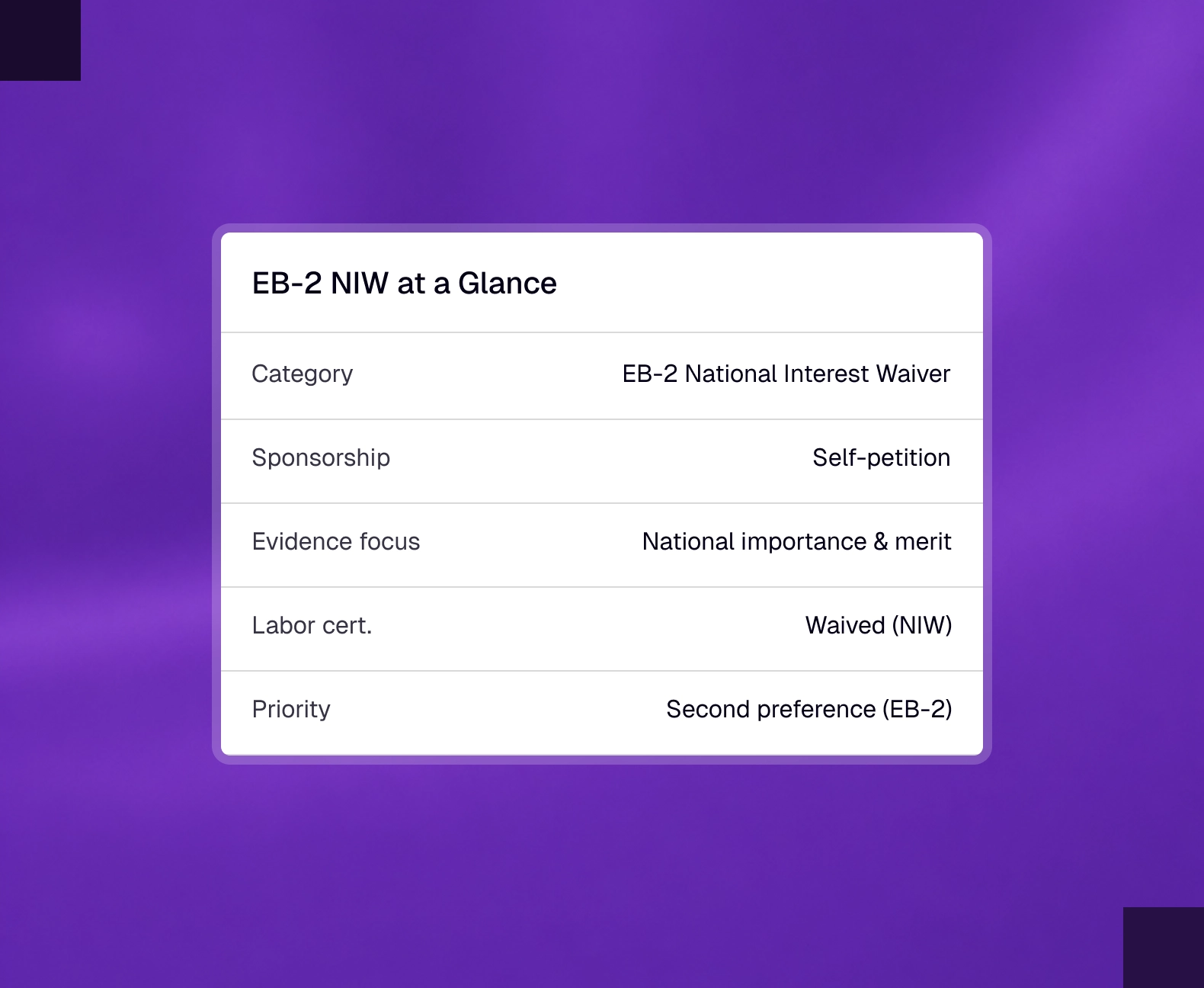
Is EB-2 NIW the Right Fit?
EB-2 NIW may be a fit for qualified professionals whose work has strong potential value to the United States and who may be able to request a waiver of the standard job offer and labor certification requirements.
01
Advanced Degree or Exceptional Ability
The candidate should first fit the underlying EB-2 category.
02
Important Proposed Work
The work should have meaningful value in the U.S.
03
Strong Candidate Positioning
The candidate should be well positioned to advance the proposed work.
04
National Interest Argument
The case should explain why waiving the standard requirements may benefit the United States.
What EB-2 NIW is Designed for
EB-2 NIW is designed for qualified individuals whose work may support the national interest.
It can be especially relevant for founders, researchers, engineers, healthcare professionals, and technical leaders working on high-impact areas.
Profiles That May Qualify
EB-1A is not limited to a single profession. The pathway is designed for individuals whose work has had documented impact across a range of fields.
- Founders
- Researchers
- Engineers
- Healthcare professionals
- Technical leaders
- Advanced degree professionals
What a Strong Case Needs to Show
The candidate should show an advanced degree, exceptional ability, or other qualifying EB-2 basis.
Show that you qualify for the underlying EB-2 category through an advanced degree or exceptional ability related to your proposed endeavor.
- Advanced degree
- Academic records
- Progressive experience
- Exceptional ability evidence
Define the proposed endeavor clearly and show why its potential impact extends beyond a single employer or customer.
- Proposed endeavor plan
- Industry evidence
- Market or research data
- Government priorities
Show that your experience, track record, progress, resources, and support put you in a strong position to advance the proposed endeavor.
- Track record
- Funding & traction
- Publications & citations
- Customers or partnerships
Show why, on balance, the United States would benefit from waiving the usual job-offer and labor-certification requirements.
- U.S. economic benefit
- Job creation potential
- National priorities
- Independent support
How LegalOS Supports the Case
LegalOS organizes the evidence gathering and case preparation workflow so your attorney can focus on strategy — not paperwork.
01
Profile Review
Assess the candidate’s background, work, evidence, and potential case direction.
02
Evidence Organization
Help gather and structure documents that support the proposed endeavor and candidate qualifications.
03
Narrative Development
Clarify the national interest argument and connect the candidate’s work to broader U.S. value.
04
Attorney Review
Experienced immigration attorneys review the case materials for completeness, quality, and legal confidence.
From Profile Review to Filing Support
We keep the process to three clear steps. Longer workflow details are covered inside the platform once you get started.
Review the Profile
Understand the candidate’s qualifications, proposed work, and evidence strength.
Build the Case Record
Organize proof of achievements, impact, traction, research, or professional recognition.
Prepare and Review
Structure the petition materials for attorney review and filing support.
Pricing for
EB-2 NIW
Purple
Complete EB-2 NIW I-140 petition preparation and filing with experienced immigration attorneys, clear communication, and visibility every step of the way.
$9,000
What's included:
- Full EB-2 NIW I-140 filing
- Live case tracking
- Attorney review backed by 40+ years of immigration experience
- Standard preparation
- Personalized case timeline
- RFE and NOID responses included
Gold
For faster, more hands-on support, Gold adds priority preparation, weekly attorney check-ins through filing, and a 60% money-back guarantee.*
$15,000
What's included:
- Full EB-2 NIW I-140 filing
- Live case tracking
- Attorney review backed by 40+ years of immigration experience
- Priority preparation in 48–72 hours
- Weekly attorney check-in calls through filing
- Personalized case timeline
- RFE and NOID responses included
- 60% money-back guarantee* (i) Eligibility and conditions apply. See our terms for full details.
Compare Related Green Card Pathways
Not sure which category fits your profile? Review the key differences between employment-based green card pathways.
EB-1A
Founders, researchers, engineers, and recognized experts with documented field impact
EB-1C
For multinational managers and executives transferring into a qualifying U.S. leadership role.
EB-2 NIW
For qualified professionals whose work may serve the national interest. Self-petition available.
FAQ
What is EB-2 NIW?
EB-2 NIW is an employment-based green card pathway for qualified individuals whose work may support the national interest.
Who is a good fit for EB-2 NIW?
It may fit founders, researchers, engineers, healthcare professionals, and other high-skill candidates working on important U.S.-relevant problems.
Does EB-2 NIW require employer sponsorship?
Many EB-2 NIW candidates may self-petition, which means an employer sponsor may not be required.
What does a strong EB-2 NIW case need?
A strong case typically needs a clear proposed endeavor, strong candidate evidence, and a well-supported national interest argument.
How does LegalOS help with EB-2 NIW cases?
LegalOS helps organize the profile, evidence, case narrative, and attorney-reviewed petition materials.
What is the EB-2 NIW green card?
The EB-2 National Interest Waiver is an employment-based green card pathway for people who qualify for the underlying EB-2 category and whose proposed work is considered important to the United States. If USCIS grants the national interest waiver, the usual job-offer and labor-certification requirements can be waived. NIW applicants may also self-petition without an employer sponsor.
Who is a good fit for the EB-2 NIW?
EB-2 NIW may be a strong fit for founders, researchers, engineers, scientists, healthcare professionals, technical leaders, and other qualified professionals whose proposed work has substantial merit and national importance. You must first qualify for EB-2 through an advanced degree or exceptional ability, then show that your proposed endeavor meets the national interest waiver standard.
Can I self-petition for an EB-2 NIW green card?
Yes. EB-2 NIW allows qualifying applicants to file Form I-140 on their own behalf without an employer sponsor. If USCIS grants the national interest waiver, you do not need the permanent job offer or PERM labor certification that normally applies to many EB-2 cases.
What are the requirements for an EB-2 NIW?
There are two stages. First, you must qualify for the underlying EB-2 category as an advanced-degree professional or a person of exceptional ability. Then USCIS evaluates three NIW factors: whether your proposed endeavor has substantial merit and national importance, whether you are well positioned to advance it, and whether, on balance, it would benefit the United States to waive the normal job-offer and labor-certification requirements.
Do I need an advanced degree to qualify for EB-2 NIW?
Not necessarily. You may qualify for the underlying EB-2 category either as an advanced-degree professional or as a person of exceptional ability in the sciences, arts, or business. For advanced-degree cases, a U.S. bachelor’s degree or foreign equivalent plus at least five years of progressive post-bachelor’s experience may qualify as the equivalent of an advanced degree in appropriate cases.
What does “national importance” mean for EB-2 NIW?
National importance focuses on the potential broader impact of your specific proposed endeavor, not simply whether your profession or industry is important. USCIS may consider factors such as economic impact, public benefit, technological or scientific advancement, job creation, national security, competitiveness, healthcare impact, or relevance to important U.S. priorities.
What does “well positioned to advance the proposed endeavor” mean?
USCIS looks at whether your background and progress show that you are capable of advancing the work you propose to pursue. Evidence can include education, specialized expertise, a record of success, publications, patents, funding, customers, partnerships, grants, business traction, research progress, and support from relevant experts, investors, users, or institutions.
Can startup founders qualify for EB-2 NIW?
Yes. Founders and entrepreneurs can qualify when they meet the underlying EB-2 requirements and can show that their proposed endeavor has substantial merit and national importance. Strong founder cases may include evidence of funding, customer traction, job creation, revenue, patents or intellectual property, industry adoption, partnerships, expert support, and a credible plan for advancing work with broader U.S. impact. USCIS specifically discusses entrepreneurs in its NIW guidance.
Can software engineers or AI professionals qualify for EB-2 NIW?
Yes. Software engineers, AI researchers, machine-learning professionals, and other technical specialists may qualify when their proposed work has broader importance to the United States and they are well positioned to advance it. USCIS specifically notes that work in critical and emerging technologies or other STEM areas important to U.S. competitiveness can be relevant to the NIW analysis.
What evidence is needed for an EB-2 NIW petition?
Evidence depends on your background and proposed endeavor, but common materials include degrees and academic records, employment history, a proposed endeavor statement or business plan, publications and citations, patents, grants, funding, customer or partnership evidence, revenue or growth metrics, recommendation or support letters, government or industry reports, and documentation showing progress toward the proposed work. USCIS evaluates business plans and letters of support alongside the broader record rather than treating them as automatically sufficient.
How long does EB-2 NIW processing take?
Processing time varies based on USCIS workload, case complexity, visa availability, and whether you later complete adjustment of status or consular processing. Premium processing is available for EB-2 NIW Form I-140 petitions and requires USCIS to take adjudicative action within 45 business days after receiving a properly filed premium-processing request. An approval of the I-140 is only one stage of the green card process, so the total timeline may be longer.
How much does an EB-2 NIW green card cost?
The current USCIS filing fee for Form I-140 is $715. Individual NIW self-petitioners generally also pay a $300 Asylum Program Fee, bringing the standard I-140 government filing total to $1,015. Optional premium processing currently costs $2,965. Adjustment-of-status or consular-processing fees, medical exams, translations, and other government or third-party costs may apply separately.
Use the LegalOS USCIS Fee Calculator to estimate the government filing fees for your case.
What happens if I receive an RFE on my EB-2 NIW petition?
A Request for Evidence, or RFE, means USCIS needs additional information before deciding the petition. In an NIW case, USCIS may question the underlying EB-2 qualification, the national importance of the proposed endeavor, whether you are well positioned to advance it, or why waiving the standard job-offer and labor-certification requirements is justified. A strong response addresses the specific concerns raised and strengthens the evidence and legal argument for the affected NIW prong.
Is EB-2 NIW better than EB-1A?
It depends on your profile. EB-1A focuses primarily on a record of extraordinary ability and sustained national or international acclaim. EB-2 NIW focuses on whether you qualify for EB-2 and whether your proposed future work meets the national interest waiver standard. Both can allow self-petitioning without a traditional employer-sponsored PERM process, but they use different legal tests and evidence strategies. Applicants with strong profiles often evaluate both pathways.
How does LegalOS handle EB-2 NIW cases?
LegalOS handles the EB-2 NIW process end to end — from eligibility review and proposed endeavor strategy through evidence development, petition preparation, attorney review, USCIS filing, and case tracking. We help define the proposed endeavor, map the evidence to the NIW framework, identify gaps in the case, prepare the petition narrative and supporting materials, and coordinate experienced immigration attorney review so your case moves through one structured process from intake to filing.

