
TN Visa Filings for Canadian and Mexican Professionals
Support eligible Canadian and Mexican professionals in qualifying roles with a clearer, attorney-backed TN process.
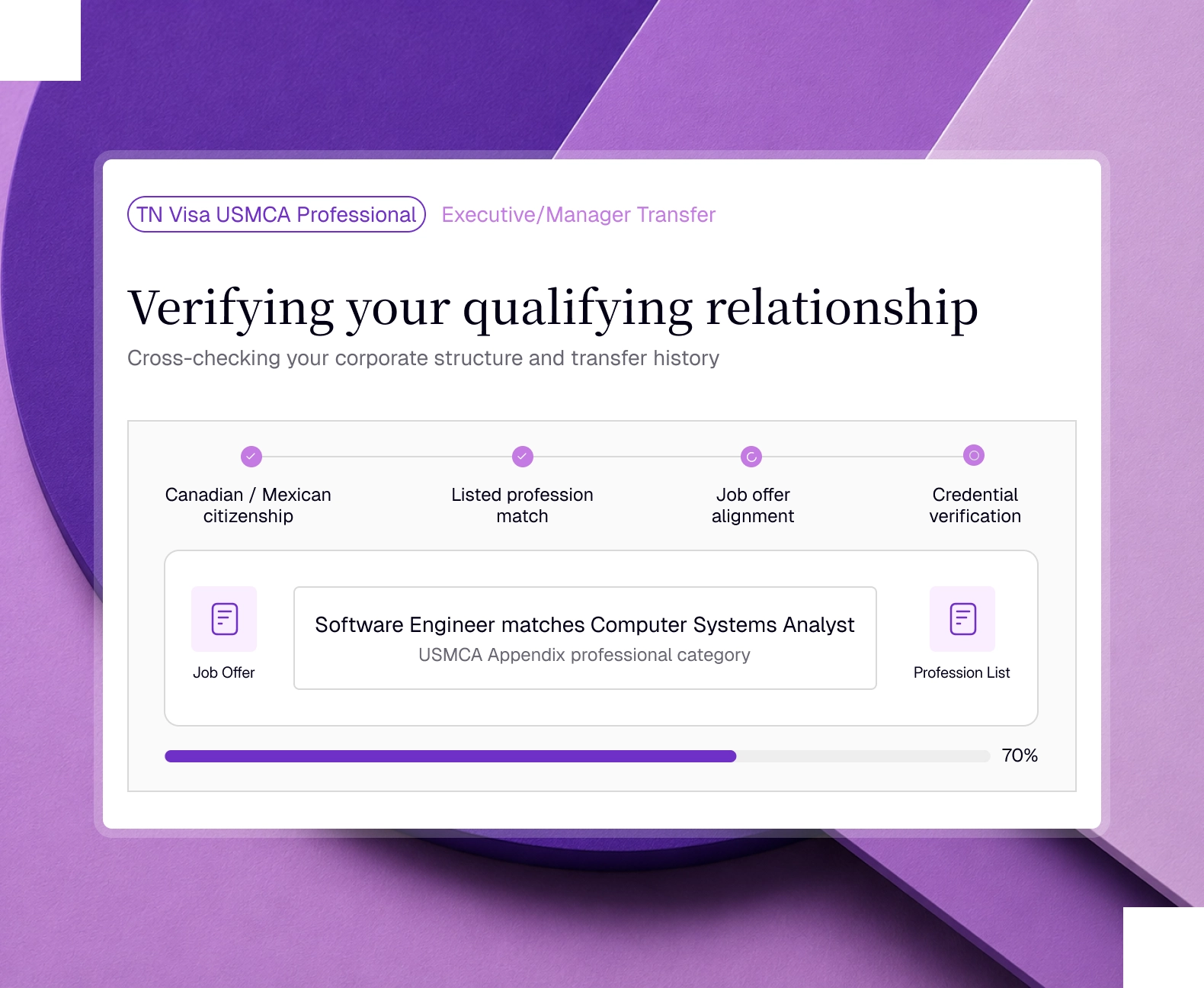
What the TN Visa Helps Teams Do
The TN classification allows qualified Canadian and Mexican citizens to seek temporary entry into the U.S. for eligible professional work. For teams hiring cross-border talent, it can support faster movement for qualifying roles.
Hire Canadian professionals
Hire Mexican professionals
Support qualifying professional roles
Move cross-border talent faster

TN Delays Can
Slow Hiring
When a role or candidate is not clearly documented, TN cases can create uncertainty around timing, start dates, and eligibility. LegalOS helps teams review role fit, credentials, and supporting materials before the case moves forward.
Traditional process
Scattered and Slow
- Unclear role eligibility
- Scattered credentials
- Slow document review
- Limited preparation support
The LegalOS process
Structured and Clear
- Role fit review
- Organized candidate materials
- Attorney-reviewed preparation
- Clearer next steps
A More Structured Way to Prepare TN Cases
LegalOS combines AI-powered workflows, structured case preparation, and experienced immigration attorney oversight — moving teams from scattered candidate information to filing-ready petition materials, faster.
Assess whether the role aligns with a qualifying TN professional category.
Collect degrees, licenses, experience, and other supporting documents.
Structure the offer details and role description clearly.
Review materials for clarity, consistency, and legal confidence.
From Intake to Filing-Ready
01
Role Intake
Capture the job title, duties, employer details, and timing.
02
Beneficiary Information
Collect citizenship, credentials, work history, and supporting candidate materials.
03
Supporting Evidence
Organize offer details, role description, and employer materials.
04
Attorney Review
Review the case materials before the candidate moves forward.




Capture the job title, duties, employer details, and timing.
Collect citizenship, credentials, work history, and supporting candidate materials.
Organize offer details, role description, and employer materials.
Review the case materials before the candidate moves forward.
Built for Teams Hiring Cross-Border Talent
Product and Technical Teams
Transfer employees with deep product, platform, architecture, implementation, or internal systems knowledge.

Global Operations Teams
Move employees who understand company-specific processes, customers, or workflows.

People and Business Leaders
Support specialized talent movement without letting documentation slow the business down.
.webp)
TN Support for
Different Hiring Needs
01
New TN Cases
Prepare materials for eligible Canadian or Mexican professionals entering a U.S. role.
02
Employer Change Support
Support TN preparation when a professional is changing employers.
03
Extension Support
Prepare materials for continued employment in a qualifying TN role.
04
Credential Review
Help teams understand whether candidate credentials align with the role.
Where Speed Meets Legal Confidence
48 hours
Applications can be prepared in as little as 48 hours.
12,000+
Successful
petitions studied.
40+ years
Immigration
expertise.
10k+
Total visas filed
by attorneys.
near 100%
Reported success rate across attorney-filed visas.
Find the Right Path for Critical Talent
LegalOS supports work visas and employment-based green cards for founders, engineers, executives, researchers, and other high-skill professionals.
Transparent Pricing
Our goal is simple: complete transparency. You'll know exactly what's included from day one, with the flexibility to choose the level of support that fits your needs.
Purple
Complete TN preparation and filing with experienced immigration attorneys, clear communication, and visibility every step of the way.
$2,000
What's included:
- Full TN filing
- Live case tracking
- Attorney review backed by 40+ years of immigration experience
- Standard preparation
- Personalized case timeline
- RFE and NOID responses included
Gold
For time-sensitive cases, Gold gives you priority preparation and faster turnaround.
$3,500
What's included:
- Full TN filing
- Live case tracking
- Attorney review backed by 40+ years of immigration experience
- Priority preparation in 48–72 hours
- Weekly attorney check-in calls through filing
- Personalized case timeline
- RFE and NOID responses included
- 60% money-back guarantee* Eligibility and conditions apply. See our terms for full details.
TN Visa
FAQs
What is the TN visa?
The TN classification allows eligible Canadian and Mexican citizens to work temporarily in the United States in certain professional occupations listed under the U.S.-Mexico-Canada Agreement (USMCA). The applicant must have prearranged professional-level employment and meet the education or credential requirements for the qualifying profession.
Who is a good fit for the TN visa?
TN status may be a good fit for a Canadian or Mexican citizen who has a temporary U.S. job offer in one of the professions specifically listed under the USMCA and meets that profession's required education, licensing, or experience requirements. TN employment must be prearranged, and self-employment is not permitted.
Do all jobs qualify for TN?
No. TN status is limited to the professional occupations listed under the USMCA, such as engineer, accountant, architect, computer systems analyst, certain scientists, and certain healthcare professionals. The position's actual duties and the applicant's qualifications must fit the applicable TN profession.
Do Canadian citizens need a TN visa?
Generally, no. Canadian citizens usually do not need to obtain a TN visa from a U.S. consulate. They can apply for TN admission directly with U.S. Customs and Border Protection at an eligible U.S. port of entry or preclearance location by presenting the required documentation. There are limited circumstances in which a Canadian may obtain or need a TN visa.
Do Mexican citizens need a TN visa?
Yes. Mexican citizens must obtain a TN visa from a U.S. embassy or consulate before requesting admission to the United States in TN status. They must then present the appropriate documentation when seeking admission at a U.S. port of entry.
Can permanent residents of Canada or Mexico qualify for TN?
No. TN classification is available only to citizens of Canada or Mexico. Permanent residents who are not citizens of either country are not eligible for TN status.
Can software engineers qualify for TN?
Potentially, but not every software engineering position qualifies. “Software Engineer” is not a separate profession on the USMCA list. Under current USCIS guidance, a person seeking TN status under the Engineer category for a computer-related position must have qualifying credentials as a computer or software engineer in a bona fide engineering specialty. The Computer Systems Analyst category may cover certain systems-analysis roles, but USCIS specifically states that it does not include programmers. Eligibility therefore depends on the position's actual duties and the applicant's credentials, not the job title alone.
What documents are usually needed for a TN case?
Requirements depend on how the applicant is applying, but a TN case generally includes proof of Canadian or Mexican citizenship, a detailed employer support letter or employment agreement, and evidence that the applicant meets the qualifications for the applicable TN profession. This may include degrees, diplomas, transcripts, professional licenses, credential evaluations, or experience letters. Mexican applicants also need the required TN visa application documents.
What should the TN employer letter include?
The employer letter should identify the qualifying TN profession and explain the professional work the applicant will perform in the United States. It should include the applicant's job duties, anticipated length of employment, relevant educational or professional qualifications, and compensation arrangements. The letter should provide enough detail to show that both the position and the applicant meet the requirements of the applicable USMCA profession.
Heading 1
Heading 2
Heading 3
Heading 4
Heading 5
Heading 6
Lorem ipsum dolor sit amet, consectetur adipiscing elit, sed do eiusmod tempor incididunt ut labore et dolore magna aliqua. Ut enim ad minim veniam, quis nostrud exercitation ullamco laboris nisi ut aliquip ex ea commodo consequat. Duis aute irure dolor in reprehenderit in voluptate velit esse cillum dolore eu fugiat nulla pariatur.
Block quote
Ordered list
- Item 1
- Item 2
- Item 3
Unordered list
- Item A
- Item B
- Item C
Bold text
Emphasis
Superscript
Subscript

