
L-1B Visa Filings for Specialized Knowledge Employees
Transfer employees with company-specific knowledge to a U.S. role with a clearer, attorney-backed process.
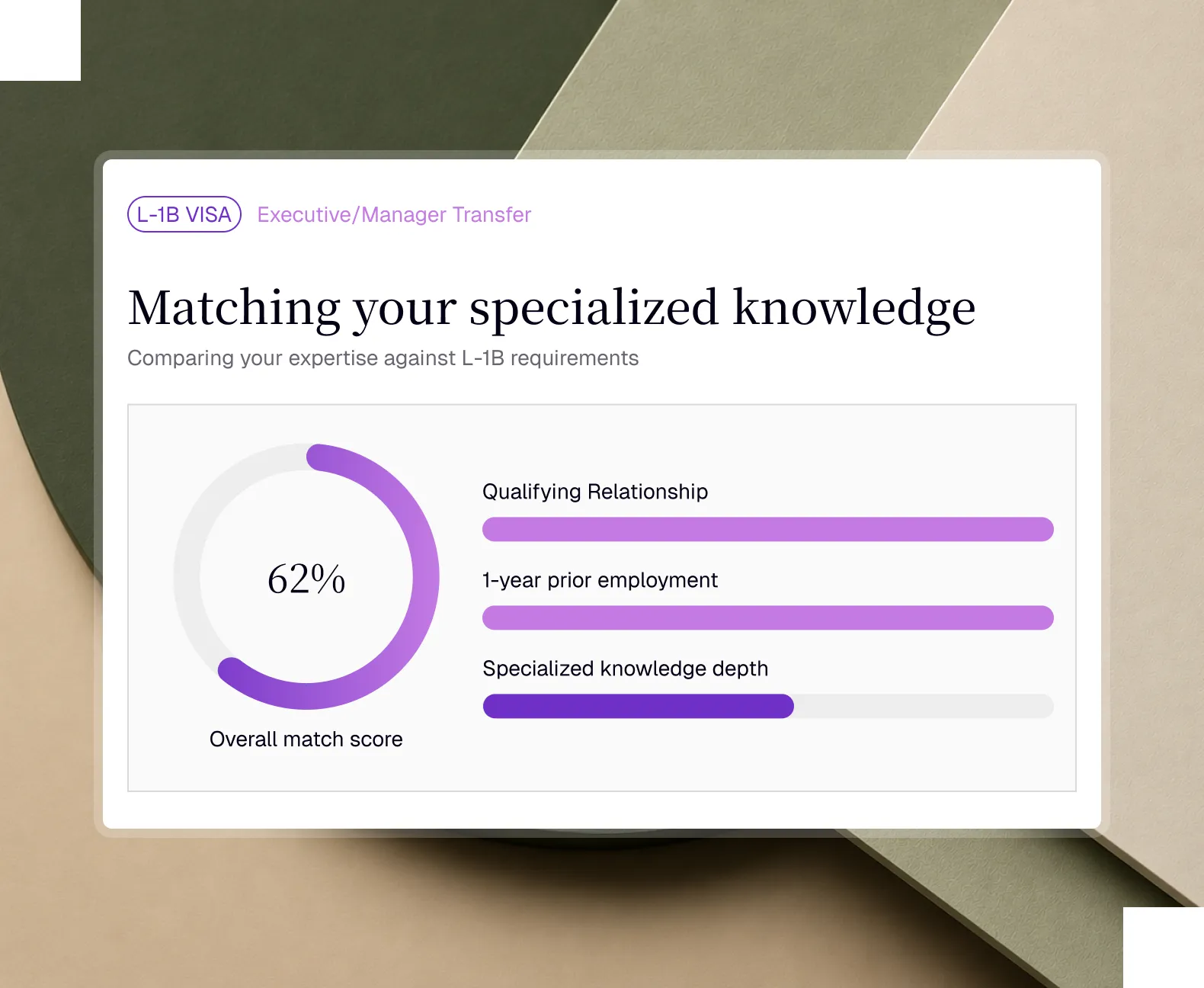
What the L-1B Visa Helps Teams Do
The L-1B visa helps companies transfer employees with specialized knowledge from a related foreign office to a U.S. office. It can support product, technical, operational, or internal knowledge transfer across global teams.
Transfer specialized employees
Support product and technical knowledge
Move key team members to the U.S.
Reduce documentation friction

L-1B Delays Can
Slow Expansion
When a specialized employee cannot move into a U.S. role on time, product timelines, customer work, implementation needs, and team continuity can be affected. LegalOS helps teams organize the evidence needed to explain the employee’s company-specific knowledge clearly.
Traditional process
Scattered and Slow
- Scattered company documents
- Unclear relationship evidence
- Slow back-and-forth
- Limited visibility into next steps
The LegalOS process
Structured and Clear
- Guided intake
- Organized company material
- Attorney-reviewed case preparation
- Clearer transfer timeline
A More Structured Way to Prepare L-1B Cases
LegalOS combines AI-powered workflows, structured case preparation, and experienced immigration attorney oversight — moving teams from scattered candidate information to filing-ready petition materials, faster.
Identify the proprietary, technical, product, or operational knowledge that supports the case.
Collect company materials that show why the beneficiary’s knowledge matters to the U.S. role.
Explain how the employee’s foreign experience connects to the U.S. position, business need, and team continuity.
Structure the case materials for review by experienced immigration attorneys.
From Intake to Filing-Ready
01
Company Intake
Capture details about the U.S. entity, foreign entity, ownership structure, and transfer need
02
Beneficiary Information
Collect employment history, knowledge area, and role-specific context.
03
Specialized Knowledge Evidence
Organize materials that help explain the beneficiary’s knowledge and why it is needed.
04
Attorney Review
Review the case materials for clarity, completeness, and legal confidence.




Capture details about the U.S. entity, foreign entity, ownership structure, and transfer need
Collect employment history, knowledge area, and role-specific context.
Organize materials that help explain the beneficiary’s knowledge and why it is needed.
Review the case materials for clarity, completeness, and legal confidence.
Built for Teams Moving Specialized Talent
Product and Technical Teams
Transfer employees with deep product, platform, architecture, implementation, or internal systems knowledge.

Global Operations Teams
Move employees who understand company-specific processes, customers, or workflows.

People and Business Leaders
Support specialized talent movement without letting documentation slow the business down.
.webp)
L-1B Support for
Different Business Needs
01
Specialized Knowledge Transfers
Prepare cases for employees with company-specific technical, product, operational, or proprietary knowledge.
02
Product Team Transfers
Support employees moving to the U.S. to help with product, platform, implementation, or customer needs.
03
Internal Systems Expertise
Help explain knowledge tied to proprietary tools, processes, systems, documentation, or workflows.
04
Global Team Continuity
Support cross-border movement when a specific employee’s knowledge is important to the U.S. team.
Where Speed Meets Legal Confidence
48 hours
Applications can be prepared in as little as 48 hours.
12,000+
Successful
petitions studied.
40+ years
Immigration
expertise.
10k+
Total visas filed
by attorneys.
near 100%
Reported success rate across attorney-filed visas.
Find the Right Path for Critical Talent
LegalOS supports work visas and employment-based green cards for founders, engineers, executives, researchers, and other high-skill professionals.
Transparent Pricing
Our goal is simple: complete transparency. You'll know exactly what's included from day one, with the flexibility to choose the level of support that fits your needs.
Purple
Complete L-1B preparation and filing with experienced immigration attorneys, clear communication, and visibility every step of the way.
$8,000
What's included:
- Full L-1B filing
- Live case tracking
- Attorney review backed by 40+ years of immigration experience
- Standard preparation
- Personalized case timeline
- RFE and NOID responses included
Gold
For faster, more hands-on support, Gold adds priority preparation, weekly attorney check-ins through filing, and a 60% money-back guarantee.*
$11,500
What's included:
- Full L-1B filing
- Live case tracking
- Attorney review backed by 40+ years of immigration experience
- Priority preparation in 48–72 hours
- Weekly attorney check-in calls through filing
- Personalized case timeline
- RFE and NOID responses included
- 60% money-back guarantee* Eligibility and conditions apply. See our terms for full details.
L-1B Visa
FAQs
What is the L-1B visa?
The L-1B is a U.S. work visa for companies that need to transfer an employee with specialized knowledge from a related foreign office to a U.S. office. It is commonly used when a U.S. team needs someone who understands the company’s product, platform, internal systems, customer implementation process, proprietary tools, or operational workflows.
Unlike the H-1B, the L-1B is not based on a lottery or a general specialty occupation role. It is based on an intracompany transfer: the employee must be moving between related companies, and the case needs to show that the employee has specialized knowledge that is needed in the U.S. role. USCIS describes L-1B eligibility as requiring specialized knowledge, a U.S. position involving that specialized knowledge, and at least one continuous year of qualifying employment abroad within the preceding three years.
Who is a good fit for the L-1B visa?
A strong L-1B candidate is usually an employee who has company-specific knowledge that would be difficult for the U.S. team to replace quickly through ordinary hiring or training. This can include deep knowledge of a proprietary product, technical architecture, customer implementation process, internal tooling, operating procedure, research system, or platform-specific workflow.
The strongest cases do not just say the employee is “important.” They explain what the employee knows, how they gained that knowledge abroad, why that knowledge is specialized, and why the U.S. role requires that specific knowledge.
What counts as “specialized knowledge” for L-1B?
Specialized knowledge generally means either special knowledge of the company’s products, services, research, equipment, techniques, management, or other interests, or advanced knowledge of the company’s processes and procedures. In plain English, the case needs to show that the employee knows something meaningfully tied to the company — not just that they are skilled in a broad profession.
For example, a software engineer may be strong for L-1B if they have deep knowledge of the company’s proprietary platform or internal systems. A customer implementation lead may be strong if they understand a company-specific deployment process that is central to U.S. customer success. A generic job title alone is not enough.
Does the specialized knowledge have to be proprietary or secret?
Not necessarily. Proprietary or unique knowledge can help support the case, but USCIS policy says L-1B does not require a finding that the knowledge is proprietary or unique. The real question is whether the employee has special or advanced knowledge that is not generally or commonly held in the relevant industry, or is sufficiently advanced within the organization.
That said, company-specific materials often matter a lot. Internal documentation, technical diagrams, product architecture, process maps, training materials, implementation plans, customer workflows, or evidence of the employee’s role in developing or applying those systems can make the case much clearer.
How is L-1B different from L-1A?
L-1A is for executives and managers. L-1B is for employees with specialized knowledge.
The distinction is about the role being transferred. A senior executive, founder, general manager, or functional manager may fit L-1A if the U.S. role is executive or managerial. A product expert, technical lead, implementation specialist, systems architect, or operations employee may fit L-1B if the U.S. role depends on specialized company knowledge.
How is L-1B different from H-1B?
The L-1B and H-1B solve different problems. The H-1B is generally used for specialty occupation roles and often depends on the cap registration process unless the employer is cap-exempt. The L-1B is for intracompany transfers and requires a qualifying relationship between the foreign company and the U.S. company, plus prior qualifying employment abroad.
The practical difference is that L-1B can be useful when a company already has a foreign employee who knows the business deeply and needs that person in the U.S. The H-1B can be useful when a U.S. employer is hiring someone into a qualifying specialty occupation, regardless of whether the person previously worked for a related foreign company.
Does the L-1B require a related foreign company?
Yes. The L-1B depends on a qualifying relationship between the U.S. company and a foreign company. The relationship is usually structured as a parent, subsidiary, affiliate, or branch relationship.
USCIS policy also requires the qualifying organization to be doing business in the United States and in at least one other country for the duration of the employee’s L-1 stay, with limited rules for new-office cases. “Doing business” means regular, systematic, and continuous provision of goods or services, not just having a registered entity or passive office presence.
What is a qualifying company relationship for L-1B?
A qualifying relationship generally means the U.S. company and the foreign company are connected as the same employer, a parent and subsidiary, affiliates, or a branch relationship. The petition should clearly document ownership, control, entity structure, and the continuing relationship between the companies.
This is one of the most important parts of an L-1B case. Even if the employee has strong specialized knowledge, the case can still run into problems if the company relationship is unclear or poorly documented.
Does the employee need to have worked abroad first?
Yes. For L-1B, the employee generally needs at least one continuous year of employment abroad with the petitioning employer or a qualifying related organization within the three years before the filing. USCIS policy says that qualifying employment can be in a managerial, executive, or specialized knowledge capacity.
This is why L-1B is not usually a fit for a new hire who has never worked for the foreign company. It is designed for intracompany transfers, not ordinary outside hiring.
What evidence is usually needed for an L-1B?
An L-1B case usually needs evidence in three buckets: company relationship evidence, employee background evidence, and specialized knowledge evidence.
Company evidence may include incorporation records, ownership documents, cap table materials, organizational charts, tax documents, financial records, office leases, and proof that the U.S. and foreign entities are actively doing business. Employee evidence may include employment verification, job descriptions, payroll records, work history, project history, and proof of the employee’s prior foreign role. Specialized knowledge evidence may include technical documents, product materials, internal process documents, training records, customer implementation materials, project artifacts, expert manager statements, and a clear explanation of why the U.S. role requires that employee’s knowledge.
How do you prove specialized knowledge?
You prove specialized knowledge by connecting the employee’s background to the company’s actual business needs. The petition should explain what the employee knows, how they learned it, why that knowledge is special or advanced, and why the U.S. role requires that knowledge.
Strong evidence often includes internal product documentation, system architecture, proprietary tools, implementation plans, customer workflows, training materials, project ownership records, manager letters, or examples of work that show the employee’s knowledge is meaningfully tied to the company rather than just the broader industry.
Can software engineers qualify for L-1B?
Yes, software engineers can qualify for L-1B when their case is built around company-specific specialized knowledge rather than generic engineering ability. For example, an engineer may be a good fit if they helped build the company’s proprietary platform, deeply understand internal architecture, own a critical implementation process, or have advanced knowledge of systems the U.S. team needs.
A software engineering title alone is not enough. The case should explain why this engineer’s knowledge is distinct, how it relates to the company’s product or systems, and why the U.S. role requires that specific knowledge.
Can product or implementation employees qualify for L-1B?
Yes. L-1B is often a strong fit for product, platform, implementation, solutions, operations, or customer success employees when their value comes from company-specific knowledge. That may include knowledge of proprietary deployment processes, customer-specific technical systems, internal tooling, integration workflows, or product behavior that is not easily learned by a new outside hire.
For these cases, the petition should avoid sounding like a generic business need. It should clearly explain the employee’s knowledge area and why that knowledge matters to the U.S. team.
Can startup employees qualify for L-1B?
Yes, startup employees can qualify for L-1B if the company can show the required foreign and U.S. company relationship, the employee’s qualifying prior employment abroad, and the specialized knowledge needed for the U.S. role. The company does not need to be a large multinational, but the documentation has to be clear.
For startups, the hardest parts are often proving the company relationship, showing that the foreign company is actively doing business, documenting the employee’s foreign role, and explaining why the employee’s knowledge is specialized rather than just “early employee” knowledge.
Can L-1B be used for a new U.S. office?
Yes, in some cases. A foreign company may use the L-1 category to transfer an employee to a new U.S. office, including a specialized knowledge employee, but new-office cases require additional documentation. USCIS policy says a new-office petitioner generally needs evidence such as sufficient physical premises and support for the intended U.S. operation.
For L-1B, the company should also be ready to explain why the U.S. launch or early U.S. operation requires this employee’s specialized company knowledge.
Can an L-1B employee work at a client site?
Sometimes, but these cases need extra care. If the employee will work primarily at an unaffiliated company’s workplace, the petitioner may need to address additional L-1B requirements, including control and supervision and the need for the employee’s specialized knowledge. USCIS specifically flags unaffiliated worksite cases as requiring additional eligibility analysis.
Can multiple employees be transferred for the same project?
Yes, companies may need to move multiple specialized knowledge employees for the same project. USCIS says it may consider grouped or “bundled” L-1 petitions when the petitions involve employees on the same project, at the same location, with substantially similar specialized knowledge duties, though each petition still needs its own evidence and filing.
This is especially relevant for product rollouts, customer implementations, technical migrations, or U.S. launch projects where several foreign employees have related company-specific knowledge.
How long does the L-1B process take?
The timeline depends on company readiness, evidence quality, attorney review, and USCIS processing. A well-prepared case can move faster when the company relationship, employee history, U.S. role, and specialized knowledge evidence are already organized.
Premium processing is available for many Form I-129 classifications and requires USCIS to take adjudicative action within the applicable premium-processing period after receiving a properly completed Form I-907. USCIS says that action can include an approval, denial, request for evidence, notice of intent to deny, or fraud/misrepresentation investigation, and the clock can stop and reset if additional evidence is required.
How long is the L-1B valid?
For an established U.S. office, an L-1B petition is often approved for up to three years initially. Extensions may be available, but L-1B status is generally limited to a maximum of five years in the United States. USCIS policy describes a five-year maximum for specialized knowledge L-1B capacity and a seven-year maximum for L-1A managerial or executive capacity.
For a new U.S. office, the initial approval period is typically shorter, often one year, because the company needs to show that the U.S. operation can support the role going forward.
Can the L-1B be extended?
Yes. L-1B status can usually be extended in increments, but only up to the maximum L-1B stay. USCIS guidance says extensions are granted in two-year increments, within the statutory limits of five years for L-1B and seven years for L-1A.
A renewal or extension is not automatic. The company still needs to show that the qualifying relationship continues, the business remains active, and the employee’s U.S. role still requires specialized knowledge.
How much does an L-1B visa cost?
An L-1B case usually includes the LegalOS service fee, USCIS filing fees, optional premium processing, and any third-party costs such as translations, courier fees, consular fees, or dependent filings.
For a standard L-1B petition, the current USCIS Form I-129 filing fee is $1,385 for most petitioners, or $695 for small employers and nonprofits. L-1B petitions also generally require the Asylum Program Fee: $600 for regular employers, $300 for small employers, and $0 for qualifying nonprofits. Initial L-1 filings typically also require the $500 Fraud Prevention and Detection Fee.
That means a typical initial L-1B government-fee total is usually $2,485 for regular employers, $1,495 for small employers, or $1,195 for qualifying nonprofits before premium processing. Optional premium processing is currently $2,965 and gives USCIS 15 business days to take action on the petition. Certain large employers with 50+ U.S. employees where more than 50% of the U.S. workforce is in H-1B or L-1 status may also owe an additional $4,500 Public Law 114-113 fee.
You can estimate government filing fees for your specific case using the LegalOS USCIS Fee Calculator.
What happens if the company gets an L-1B RFE?
An RFE, or Request for Evidence, is not a denial. It means USCIS needs more information before deciding the petition. In L-1B cases, RFEs often focus on the qualifying company relationship, whether the foreign and U.S. entities are doing business, whether the employee had qualifying foreign employment, whether the U.S. role requires specialized knowledge, or whether the evidence clearly explains the knowledge area.
If you receive an RFE, LegalOS helps review what USCIS is asking for, identify the weak points in the petition, organize additional evidence, and prepare an attorney-reviewed response.
Can family members come with an L-1B employee?
Yes. The spouse and unmarried children under 21 of an L-1B employee may generally seek L-2 dependent status. USCIS states that spouses and children of temporary workers who qualify for dependent classification may apply at a U.S. consulate if outside the United States, or may file Form I-539 for change or extension of status if inside the United States. USCIS also says E and L spouses are employment-authorized incident to status and no longer need to file Form I-765 just to be authorized to work, though they may still choose to file for an EAD.
Can an L-1B lead to a green card?
Yes, an L-1B is a temporary work visa, but some L-1B employees later pursue employment-based green cards. The right path depends on the employee’s role, qualifications, employer sponsorship, country of birth, and long-term U.S. plan.
For many L-1B employees, the green card path may be EB-2 or EB-3 through employer sponsorship. EB-1C is more closely associated with multinational executives and managers, so it usually fits L-1A-style roles better than ordinary L-1B specialized knowledge roles. If the employee later moves into a true executive or managerial role, the long-term strategy may change.
Can an L-1B employee change employers?
Not freely in the way many people think about changing jobs. The L-1B is tied to the qualifying company group that sponsored the petition. If the employee wants to move to an unrelated employer, they usually need a different work visa or immigration strategy.
An L-1B employee may be able to move between qualifying related entities or into a materially changed role, but changes can require immigration review and, in some cases, an amended petition.
What happens if the company ownership structure changes?
A change in ownership, control, or company relationship can affect the L-1B petition because the visa depends on a qualifying relationship between the U.S. and foreign entities. USCIS policy notes that changes in ownership and control after approval can require an amended petition when they are material.
For startups, this is especially important after financing rounds, acquisitions, restructurings, or entity changes. The company should review whether the qualifying relationship still exists before relying on the old petition structure.
Is L-1B better than H-1B?
It depends on the company and employee. L-1B may be better when the employee already works for a related foreign company and has specialized knowledge the U.S. team needs. It avoids the H-1B cap lottery, but it requires the right intracompany relationship and prior foreign employment.
H-1B may be better when the company is hiring someone who does not already work for a related foreign entity, or when the case is better framed around a specialty occupation role rather than company-specific knowledge.
Should we choose L-1A or L-1B?
Choose L-1A when the U.S. role is genuinely executive or managerial. Choose L-1B when the U.S. role depends on specialized company knowledge.
This is not just a title question. A “Head of Product” might be L-1A if they manage a function or make executive-level decisions, but L-1B if the case is really about their specialized knowledge of the product, platform, or implementation system. LegalOS can help review the role, company structure, employee history, and evidence to determine which pathway is stronger.
What are common L-1B mistakes?
Common L-1B mistakes include treating the case like a generic skilled-worker petition, failing to document the company relationship, relying on job titles instead of evidence, using vague phrases like “critical employee” without explaining the actual knowledge, and submitting company documents without connecting them to the employee’s U.S. role.
The best L-1B cases are specific. They show the employee’s knowledge area, explain how the knowledge was gained abroad, document why the knowledge is special or advanced, and connect that knowledge directly to the U.S. business need.
How does LegalOS help with L-1B cases?
LegalOS handles the L-1B process end-to-end — from company intake and beneficiary intake to evidence strategy, specialized knowledge narrative, petition preparation, attorney review, filing support, and live case tracking.
We help organize the company relationship documents, employee history, U.S. role details, specialized knowledge evidence, and case narrative so the petition is built around the actual transfer need. Instead of managing scattered documents, unclear requirements, and slow legal back-and-forth, teams get one structured process built to move the L-1B case from intake to filing-ready.
Who reviews my L-1B petition?
Your L-1B petition materials are reviewed by experienced immigration attorneys before filing. LegalOS helps structure the intake, evidence, role narrative, company materials, and petition package, while attorneys review the case for legal strategy, completeness, consistency, and filing readiness.
This keeps the process faster and more organized without removing attorney oversight from the parts of the case where legal judgment matters most.
What is included in LegalOS pricing?
LegalOS pricing includes structured L-1B case preparation, company and beneficiary intake, evidence organization, petition materials, attorney coordination, filing support, and case visibility.
Government filing fees, optional premium processing, consular costs, translation costs, courier fees, dependent filings, or other third-party expenses may be separate. Teams can estimate government filing fees for L-1B using the LegalOS USCIS Fee Calculator.
How fast can LegalOS prepare an L-1B case?
LegalOS can move quickly when the company and employee materials are ready. The timeline depends on how organized the company relationship evidence, foreign employment history, U.S. role details, and specialized knowledge materials are at intake.
For strong, well-documented cases, LegalOS helps teams move from scattered information to attorney-reviewed petition materials much faster than a traditional back-and-forth process. USCIS premium processing can speed up agency review, but it does not guarantee approval and may result in an RFE or other adjudicative action instead of an approval.
What should companies prepare before starting an L-1B case?
Companies should prepare documents showing the U.S. and foreign company relationship, proof that both entities are doing business, the employee’s foreign employment history, the proposed U.S. role, and evidence of the employee’s specialized knowledge.
A good starting packet often includes ownership documents, organization charts, foreign and U.S. role descriptions, employment verification, payroll records, product or process documentation, internal training materials, project history, customer implementation materials, and a clear explanation of why this employee is needed in the U.S.
Heading 1
Heading 2
Heading 3
Heading 4
Heading 5
Heading 6
Lorem ipsum dolor sit amet, consectetur adipiscing elit, sed do eiusmod tempor incididunt ut labore et dolore magna aliqua. Ut enim ad minim veniam, quis nostrud exercitation ullamco laboris nisi ut aliquip ex ea commodo consequat. Duis aute irure dolor in reprehenderit in voluptate velit esse cillum dolore eu fugiat nulla pariatur.
Block quote
Ordered list
- Item 1
- Item 2
- Item 3
Unordered list
- Item A
- Item B
- Item C
Bold text
Emphasis
Superscript
Subscript

